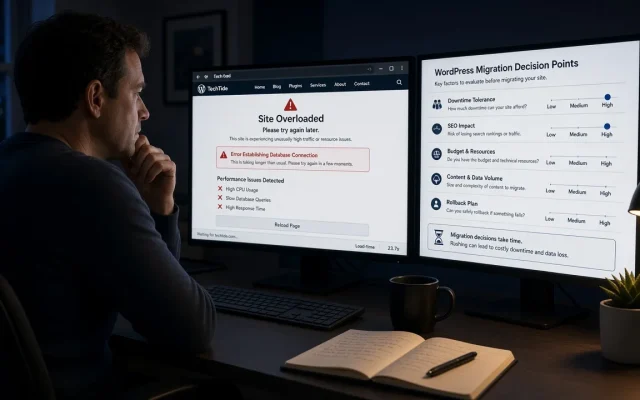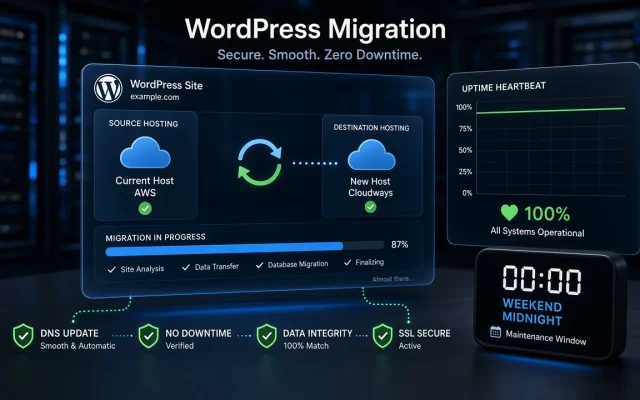
Changing domains moves every URL your site owns. Do it right and rankings transfer within weeks; do it wrong and you donate a decade of authority to the void. The domain change is a superset of a server migration — the standard checklist applies, plus this layer.
Preconditions
- Own both domains during the transition — the old domain must keep resolving for a year minimum, both for redirects and for the old links the internet will keep clicking.
- Both serve the same site before the switch: new domain on the same server (or hosts-file preview) fully working, SSL included.
The URL replacement
wp search-replace "https://old.com" "https://new.com" --all-tables --allow-root — serialized-safe by design (raw SQL corrupts options, the mechanism in the mixed-content guide). Then purge every cache: page, object, builder, CDN. Old-domain references survive in caches longer than in the database.
The redirect layer (where rankings live or die)
Every old URL must 301 to its new counterpart — path-preserving, not domain-root-only. Redirecting everything to the homepage is the classic self-inflicted wound: it tells search engines your articles vanished.
- Same server: a server-level rule mapping
old.com/path→new.com/pathcovers all URLs in one line. - Different servers: keep the old site running as a pure redirect layer for a year.
- Verify with curl on a sample of your most-linked pages — 301, single hop, correct target. Chains dilute signal and add latency.
Search Console: the change of address
- Verify the new domain property in Search Console.
- Submit the new sitemap (https://new.com/sitemap.xml).
- Use the Change of Address tool from the old property — it accelerates signal transfer when the 301s are in place.
- Update canonical tags if any theme/plugin hardcodes the domain (search-replace usually handles this; verify the output).
The monitoring month
- Week 1–2: expect flux — impressions dip and recover as signals transfer. Track daily, not hourly.
- Watch for 404 spikes in Search Console coverage — missed redirects surface there first.
- Backlinks: the internet keeps linking to old URLs; the redirect layer is doing its job. Major partners can be asked to update links, but 301s are the durable fix.
- Analytics: keep continuity by configuring the new property with the same events; note the cutover date on every report you share.
What not to do
- Don’t change the site structure simultaneously — domain and URL-structure changes together make attribution of ranking shifts impossible. Stage them months apart.
- Don’t let the old domain expire early — the redirect layer is your ranking insurance.
Not permanently, if every old URL 301-redirects path-preservingly and Search Console's Change of Address is used. Expect 2–4 weeks of flux while signals transfer. A year minimum — the redirect layer preserves rankings and serves the internet's existing links. Early expiry donates those signals to nobody. Matching pages, always. Homepage-only redirects tell search engines your articles disappeared — path-preserving 301s are what transfer rankings.Will changing my domain lose my SEO rankings?
How long should the old domain stay active?
Should redirects go to the homepage or matching pages?
How do I replace the domain in the WordPress database?